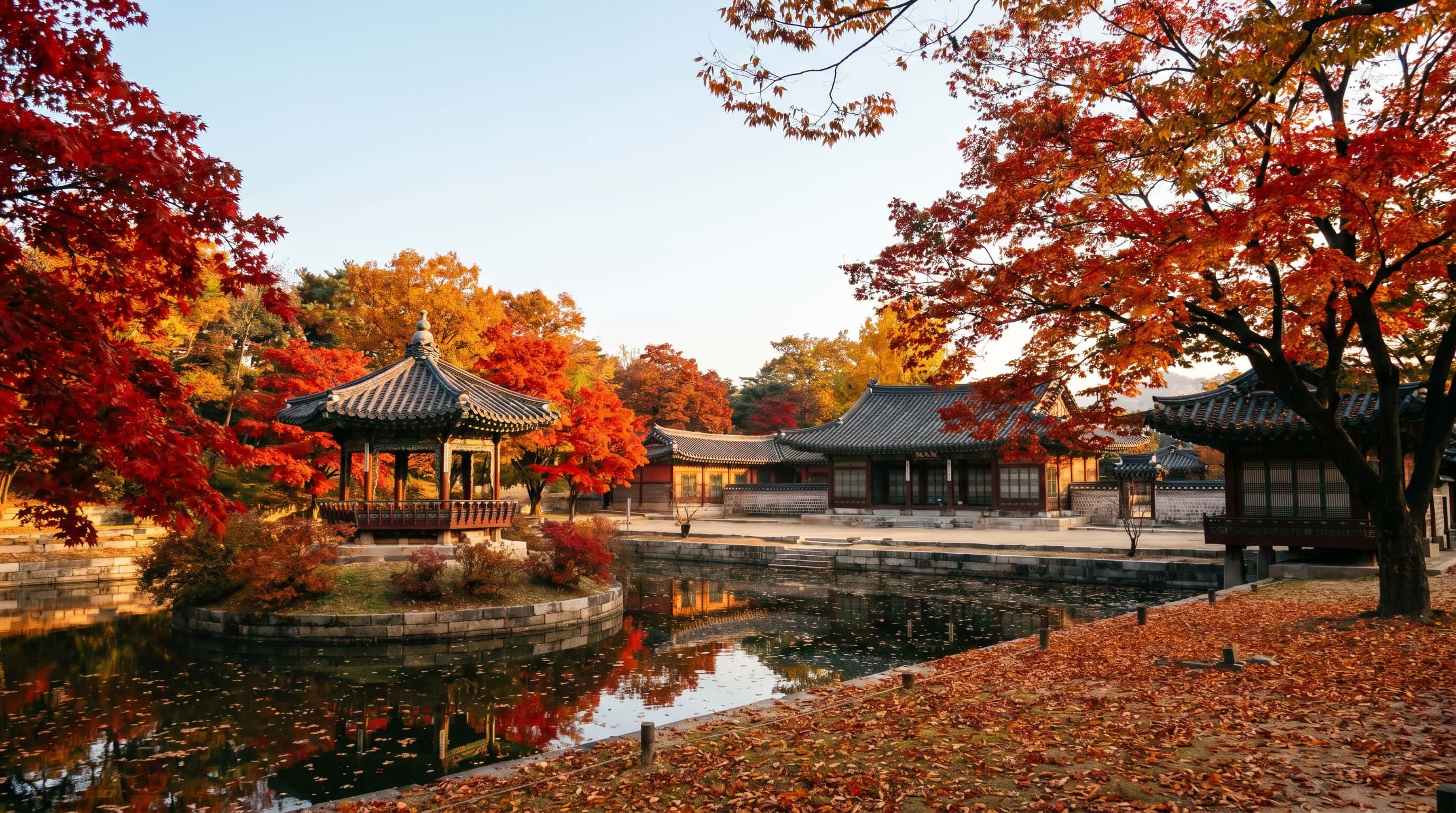
South Korea's tourism calendar is bracketed by two distinct surges: cherry blossom season (late March to mid-April), which drives one of Asia's most intense short-window travel spikes, and summer vacation (July-August), when both domestic Korean tourism and international visitors peak. Between those surges — roughly May 15 to June 20 — lies a window that most travelers skip entirely. KTO data shows visitor counts drop meaningfully from the April peak, Seoul temperatures sit at a mild 18-23°C, and the full range of Korean cultural experiences (palaces, markets, food, K-culture districts) remains completely accessible. The gap exists. Almost nobody plans for it.
How we evaluated
This piece pulls from three public sources. Korea Tourism Organization (KTO) monthly inbound visitor statistics, which are published openly and identify exactly when international arrivals peak and trough across the year. Google Flights historical pricing data for US-to-Seoul (ICN) routes, showing month-over-month fare variation. And r/korea and r/solotravel Korea community threads, where the same handful of timing recommendations come up repeatedly. No first-hand visits informed this piece — the case is built on the published visitor data, the pricing record, and traveler consensus.
The verdict
Mid-May to mid-June — specifically the May 15 to June 20 window — earns a Worth-It Score of 8.5 as Korea's overlooked value window. It sits after the cherry blossom international surge ends in late April, after Korea's domestic Children's Day and Buddha's Birthday holiday traffic clears, and before the summer humidity and the July-August vacation peak. Crowd density at major sites (Gyeongbokgung Palace, Bukchon Hanok Village, Myeongdong) drops materially from the April peak, US-to-Seoul flight pricing softens, and the weather is genuinely mild — warmer than cherry blossom season's lingering chill, cooler than July's heat and humidity.
The evidence
What KTO data shows
Korea Tourism Organization monthly inbound visitor statistics consistently identify April (cherry blossom peak), July, August (summer vacation), and October (autumn foliage) as the four highest-traffic months for international arrivals. May visitor counts drop noticeably from the April peak, with the dip continuing into early June before climbing back into the summer surge. The pattern is stable year over year (excluding pandemic-era anomalies, which the data also reflects). The dip is not at the level of a deep low season — Korea is a year-round destination — but it is a real and measurable gap between the spring and summer peaks that mainstream Korea travel coverage rarely surfaces.
The flight pricing gap
Historical pricing data from Google Flights for US-to-Seoul (ICN) routes consistently shows mid-to-late May flights pricing measurably below late March and April flights on the same origin-destination pairs (based on Q1 2026 booking data). The mechanism is straightforward: cherry blossom demand inflates April pricing, that demand collapses fast once the bloom ends, and summer vacation demand hasn't yet pushed pricing into its July-August peak. May fares from the major US gateway cities (LAX, SFO, JFK, ORD, SEA) typically run 15-25% below April fares on the same routes, and 20-30% below July fares. Independent fare-tracking analyses for Asia routes show the same May soft point recurring across years.
What's available in May that isn't seasonal-dependent
The bulk of what travelers come to Korea for is fully operational in May with no seasonal dependency. Gyeongbokgung Palace and the Changing of the Guard ceremony run their normal schedules. Bukchon Hanok Village is open and substantially less crowded than during cherry blossom season. Myeongdong, Hongdae, Itaewon, and Gangnam all run on year-round schedules. Korean BBQ, street food, cafe culture, and the full K-culture entertainment circuit (BTS-related sites, K-drama filming locations, KPop district experiences) are completely accessible. Han River parks come into peak use in May with picnics, biking, and outdoor concerts beginning their summer run. Day trips to the DMZ, Suwon Hwaseong Fortress, and Nami Island all run normal schedules.
The weather case for May
Cherry blossom season in Korea — typically late March through mid-April — coincides with the back end of Korean winter. Temperatures during that window can dip into single digits Celsius, and the famous blossom photographs are often taken in coats. By mid-May, Seoul temperatures average 18-23°C with low humidity — close to ideal for sustained walking and outdoor activity. The summer humidity that arrives in late June and intensifies through August has not yet established itself. Rain frequency picks up in late June with the start of the monsoon (jangma) season; mid-May to mid-June stays well ahead of that pattern.
Buddha's Birthday and the Lotus Lantern Festival
Buddha's Birthday — a public holiday in South Korea — typically falls in May (the date moves with the lunar calendar). The Lotus Lantern Festival (Yeondeunghoe) runs in the days surrounding the holiday and is one of Korea's most visually striking cultural events: thousands of paper lanterns illuminate Jogyesa Temple in central Seoul and a major lantern parade winds through Jongno-gu. UNESCO inscribed Yeondeunghoe on the Representative List of the Intangible Cultural Heritage of Humanity in 2020. Despite this, the festival is largely unknown to international travelers and runs without the international crowd density that cherry blossom season brings.
What community consensus shows
r/korea and r/solotravel Korea threads consistently surface mid-May as an underrecommended window for first-time visitors. The recurring framing in these threads: cherry blossoms are crowded, expensive, and weather-dependent; mid-May offers warmer weather, lower pricing, lower crowd density, and access to the full Seoul experience. Trip reports from travelers who visited in mid-to-late May describe walking up to Gyeongbokgung's main gate without a queue, getting reservations at sought-after Korean BBQ restaurants without weeks of advance planning, and photographing Bukchon Hanok Village without crowd management.
Who it's best for
For: K-culture, food, and entertainment travelers
The full K-culture circuit — entertainment district experiences, Korean BBQ, café culture, K-drama and KPop-related sites — is fully operational in mid-May with materially lower crowd density than the cherry blossom or summer surges. Restaurant reservations and tour bookings open up significantly.
For: First-time Korea visitors
Mid-May offers the best balance of weather, pricing, and access for a first Korea trip. Palaces, hanok villages, markets, and day trips all run normal schedules without the cherry blossom or summer crowd density that defines the famous Korea travel windows.
For: Asia travelers seeking value between peak windows
For multi-stop Asia itineraries, mid-May Korea aligns with shoulder windows in Japan and Taiwan, allowing travelers to chain multiple Asian destinations during their respective value gaps rather than fighting peak pricing across the region.
What it doesn't beat
Mid-May does not beat late March to mid-April for cherry blossoms — there is no clever workaround, and travelers whose primary purpose is hanami should book the cherry blossom window with eyes open about the cost and crowd trade-off. It does not beat October for autumn foliage colors across the Korean national parks (Seoraksan, Naejangsan), which is its own specific seasonal scene. And it does not beat winter for Pyeongchang and Gangwon-do ski experiences. Mid-May is the right answer for the Korea experience itself, not for a specific seasonal scene.
Verdict
The Verdict
Mid-May to Mid-June Travel Window for South Korea
Best For
First-time Korea visitors and K-culture travelers who want the full Seoul experience at below-peak pricing without cherry blossom crowds
Beats
April on crowd density and flight pricing; July-August on humidity and domestic tourism congestion
Doesn't Beat
Late March to mid-April for cherry blossom visuals; October for autumn foliage colors across Korean national parks
Based on 3 data sources · Last verified May 14, 2026
Sources
- Korea Tourism Organization (KTO) monthly inbound visitor statistics (expert-analysis) — official monthly visitor counts identifying the cherry blossom and summer peaks and the May valley between them
- Google Flights historical pricing for US-to-Seoul (ICN) routes (pricing-data) — month-over-month fare variation showing the May soft point in the annual fare curve
- r/korea and r/solotravel Korea community timing discussions (community-consensus) — recurring threads identifying mid-May as an underrecommended Korea window