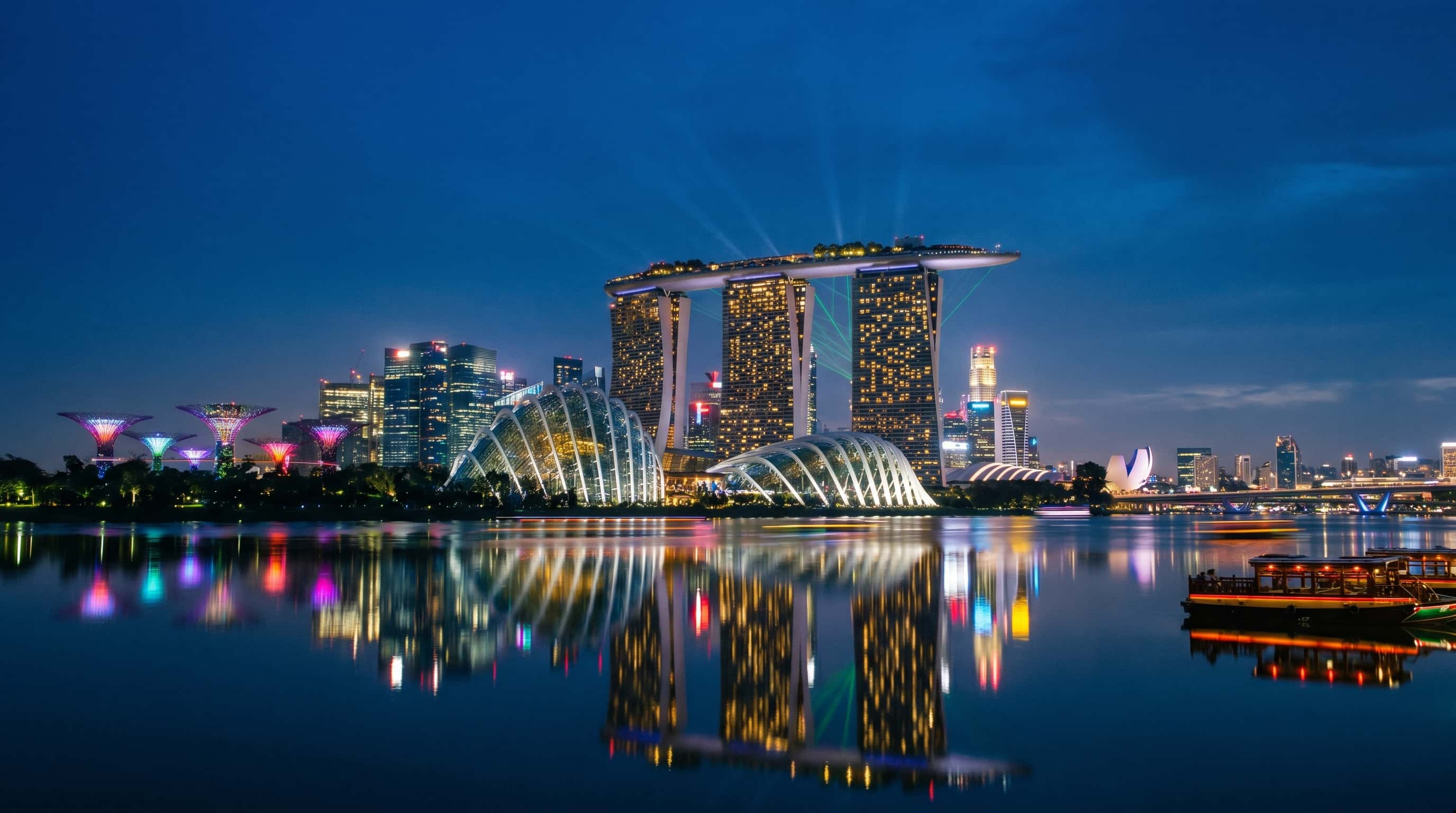
Singapore is one of the only major international destinations where the question "when should I visit?" has an unusual answer: almost any time. The city-state sits 1° north of the equator, maintains 29-32°C year-round, and has no meaningful cold or heat season to avoid. But hotel prices vary — and the northeast monsoon season (November-January) creates a 20-30% pricing drop while delivering almost no meaningful degradation to the tourist experience. Most monsoon rain falls in the evening and overnight. Gardens by the Bay, Marina Bay Sands, hawker centres, Sentosa, and Singapore Zoo are climate-controlled or covered and entirely unaffected. This is one of the only places in travel where the "off-season" pricing gap isn't accompanied by an off-season experience gap.
How we evaluated
This verdict draws from three data sources. Singapore Tourism Board (STB) monthly visitor arrival statistics, which document how international arrivals shift during the northeast monsoon and the resulting effect on hotel pricing. Historical hotel pricing data for Singapore across seasons, comparing the November-January window to peak periods. And community consensus from r/singapore and r/solotravel timing discussions, where travelers consistently report monsoon season's minimal practical impact on the typical Singapore itinerary. No first-hand stays inform this verdict.
The verdict
The November-to-January northeast monsoon window earns a Worth-It Score of 7.5 as Singapore's clearest value timing. STB visitor data confirms a measurable arrival dip during these months, and hotel pricing across mid-range and upscale categories runs 20-30% below the March-August peak (based on Q1 2026 booking data). Because the vast majority of Singapore's signature experiences are indoor or covered, the practical experience trade-off is minimal — making this one of the rare destinations where shoulder-season pricing comes without shoulder-season compromises.
The evidence
What STB visitor data shows
Singapore Tourism Board publishes detailed monthly arrival statistics, and the pattern is consistent year over year: international visitor volume softens noticeably in the November-January monsoon window before rebounding for the dry-season months of February through April and the regional summer holiday window of June-August. The arrival dip isn't dramatic — Singapore's role as a regional business and connectivity hub means baseline traffic stays high — but it's enough to move hotel pricing meaningfully. The mechanism is straightforward: leisure travelers from rainier-conscious source markets defer trips during the monsoon months, opening rate flexibility that doesn't exist during peak demand windows.
The precipitation reality
Data from Singapore's Meteorological Service and the broader BMKG/NEA regional climate record consistently show that the northeast monsoon's rainfall is concentrated in evening and overnight hours, not daytime. Average daytime rainfall during the monsoon window typically lands in the 40-60 minute range across a 24-hour period, often arriving as a single afternoon thunderstorm cell that clears within an hour. The "monsoon" framing creates an expectation of all-day downpours that simply isn't supported by the precipitation data — most monsoon-season days deliver several hours of usable outdoor time even before factoring in indoor alternatives.
The experience checklist
Singapore's tourist experience is dominated by climate-controlled and covered venues. Gardens by the Bay's Cloud Forest and Flower Dome are fully indoor. Marina Bay Sands' shopping, casino, and observation deck are unaffected. Every hawker centre — Lau Pa Sat, Maxwell, Newton, Old Airport Road, Tiong Bahru — operates under cover. The Singapore Zoo and Night Safari are designed for tropical rain. Universal Studios at Sentosa, the National Gallery, the ArtScience Museum, the Asian Civilisations Museum, Jewel Changi, and the entirety of Orchard Road shopping are all weather-independent. The only experiences meaningfully affected are outdoor rooftop pools (which most travelers use briefly anyway) and outdoor festival programming concentrated in other months.
The 20-30% pricing gap
Historical hotel pricing data across Singapore's mid-range and upscale tiers shows a consistent November-January discount versus the March-June peak (based on Q1 2026 booking data). Mid-range properties in the $250-350 SGD range during peak season frequently appear at $180-260 SGD during the monsoon window. Upscale properties — Marina Bay Sands, the Fullerton, Raffles, the Capitol Kempinski — show similar percentage discounts on standard categories, often combined with breakfast or credit promotions that don't appear during peak demand. For a 4-night Singapore stay, the pricing differential alone often exceeds $400 SGD per traveler.
The F1 Grand Prix exception
There is one Singapore month that genuinely should be avoided unless you specifically want the experience: September. The Singapore Grand Prix — Formula 1's signature night race — takes place over a weekend in mid-to-late September and produces hotel pricing spikes of 100-300% across the city-centre district. Marina Bay properties book months in advance at premium rates, traffic and access around the circuit are heavily restricted for the better part of two weeks, and even properties well outside the race zone command surge pricing. Travelers who specifically want F1 atmosphere should plan for it explicitly. Travelers who don't should avoid September entirely — it's the only month where Singapore's pricing genuinely punishes uninformed timing.
Who it's best for
For: First-time Singapore visitors
The standard first-time itinerary — Marina Bay, Gardens by the Bay, hawker food crawls, Sentosa, the historic quarters, Orchard Road shopping — is dominated by indoor and covered experiences. The November-January window delivers this full itinerary at meaningfully lower cost without compromising what most first-timers came for.
For: Asia hub travelers on a layover or short stop
Singapore's role as a Southeast Asian connection hub means many travelers visit on 2-4 day stops. The monsoon window's pricing advantage is particularly compounding on shorter stays where accommodation is the largest budget line, and the indoor-heavy short-stop itinerary is essentially weather-proof.
For: Indoor experience, food, and shopping travelers
For travelers whose Singapore priorities are food (hawker centres, restaurants, the world-class dining scene), shopping (Orchard Road, Bugis, Marina Bay Sands), and indoor cultural attractions (museums, gardens, Jewel Changi), the November-January window is functionally identical to peak season at 20-30% lower cost.
What it doesn't beat
The November-January window does not beat March-August for outdoor rooftop pool weather, when daytime humidity and cloud cover are at their lowest and pool conditions are at their best. It does not beat February-April for outdoor Marina Bay waterfront strolling and Gardens by the Bay outdoor exploration in fully clear conditions. And it does not beat September for the Formula 1 Grand Prix experience — though September is also the one month where pricing makes Singapore meaningfully more expensive than alternatives, so this is a deliberate trade rather than a default.
Verdict
The Verdict
November–January Northeast Monsoon Window for Singapore
Best For
First-time Singapore visitors and Asia stopover travelers whose itinerary centers on indoor experiences, food, and shopping — the vast majority of Singapore visits
Beats
March–August on hotel pricing with minimal experience trade-off for indoor-focused itineraries
Doesn't Beat
March–August for outdoor rooftop pool and Marina Bay waterfront weather; September F1 Grand Prix period for atmosphere (pricing spikes significantly)
Based on 3 data sources · Last verified May 15, 2026
Sources
- Singapore Tourism Board (STB) monthly visitor arrival statistics (expert-analysis) — official monthly arrival data documenting the northeast monsoon visitor dip and resulting hotel pricing softness
- Historical hotel pricing data for Singapore across seasons (pricing-data) — accommodation rate comparison showing the 20-30% pricing gap between November-January and peak periods
- r/singapore and r/solotravel Singapore community timing discussions (community-consensus) — accumulated traveler reports on Singapore's year-round visitability and the minimal practical impact of monsoon weather on the standard tourist itinerary