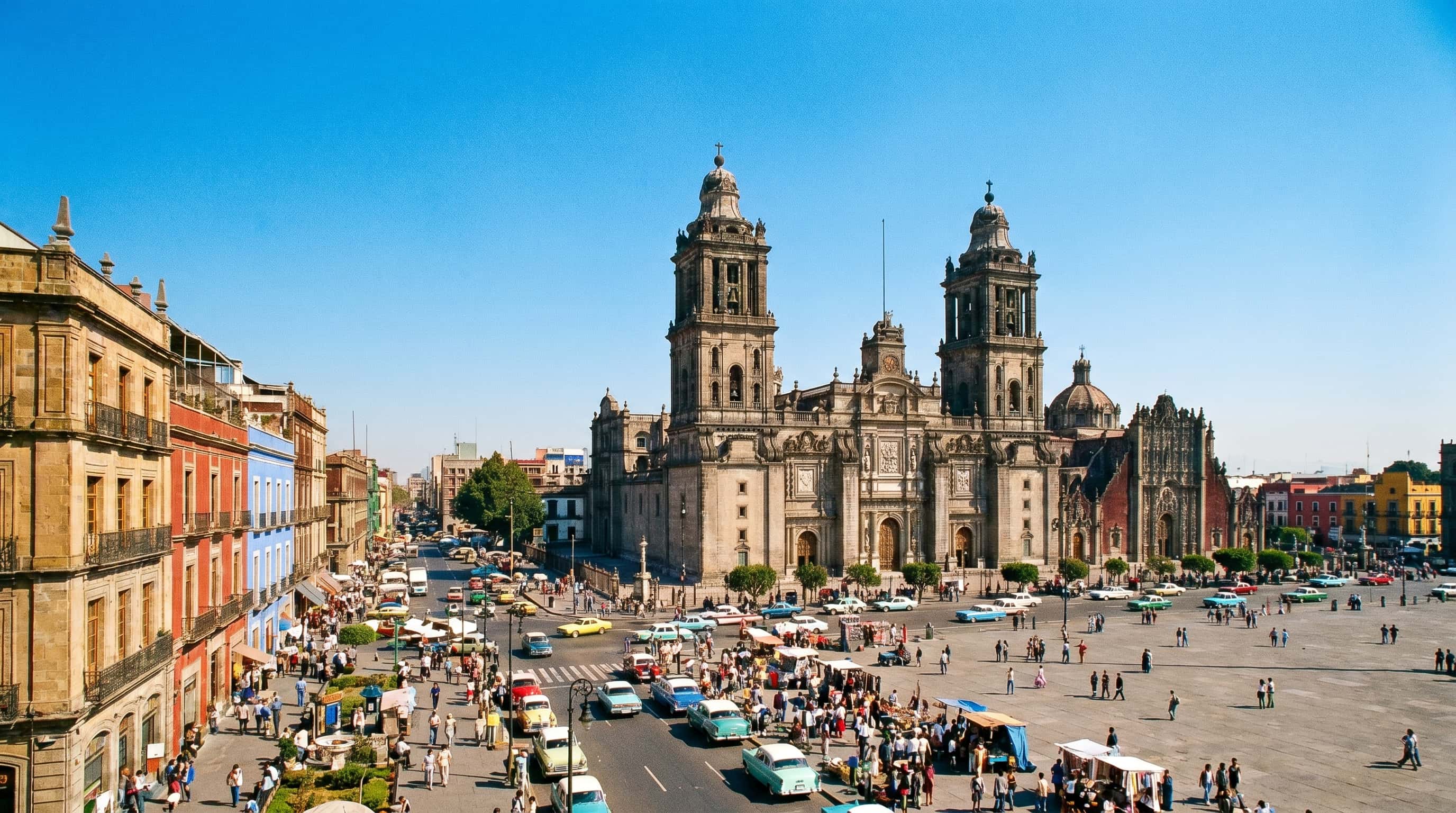
Mexico City's most photographed seasonal event isn't Día de los Muertos — it's the jacaranda bloom. From late February through March, jacaranda trees explode purple across the city's boulevards and parks, particularly in Roma Norte, Condesa, and around UNAM. It's one of Latin America's most visually striking seasonal events, widely celebrated by locals and almost entirely unknown to international travelers. March-April also happens to be Mexico City's ideal weather window: dry season is in full effect (the rainy season doesn't arrive until May), temperatures sit at a comfortable 20-25°C, and flight pricing from US hubs runs 20-30% cheaper than December-January.
How we evaluated
This verdict draws from three data sources. Mexico City Tourism Secretariat (Sectur CDMX) monthly visitor data, which documents the December-January peak and the March-April pricing valley. Google Flights historical pricing for US-to-Mexico City (MEX) routes, showing month-over-month fare variation across major US hub origins. And r/MexicoCity and r/solotravel community timing discussions, where frequent CDMX visitors consistently identify March-April as an underrecommended window. No first-hand stays inform this verdict.
The verdict
March through April earns a Worth-It Score of 9.0 as Mexico City's strongest combination of weather, pricing, atmosphere, and access. Sectur CDMX visitor data shows international arrivals dip measurably between the December holiday peak and the May start of the rainy season. Flight pricing from US hubs runs 20-30% below December levels (based on Q1 2026 booking data), while the city itself is in its best weather and air-quality window of the year. The jacaranda bloom adds a visual layer that doesn't exist in any other month.
The evidence
What Sectur CDMX visitor data shows
Mexico City's tourism secretariat publishes monthly visitor data that maps the city's clear seasonal pattern: December and January are the peak international tourism window, driven by US holiday travel and the Día de los Muertos extension effect. February shows a transitional dip, and March-April register as a measurable visitor valley before international arrivals rebuild through summer. The arrival gap between December and March-April is meaningful enough to move hotel pricing, restaurant reservation availability, and museum crowd density at major sites — Frida Kahlo's Casa Azul, the Anthropology Museum, and the Templo Mayor all see noticeably shorter queues in March-April than in December.
The jacaranda bloom
The jacaranda bloom is Mexico City's most distinctive and least-marketed seasonal event. Late February through mid-March, thousands of jacaranda trees across the city flower simultaneously, turning entire avenues and plazas purple. Paseo de la Reforma's central median, the boulevards of Roma Norte and Condesa, the UNAM university campus, and Parque México are particularly striking. The trees were planted across the city throughout the 20th century — initially as a Japanese diplomatic gift adapted by landscape architect Tatsugoro Matsumoto — and the bloom has become a celebrated local phenomenon documented extensively in Mexican media each year. International coverage is minimal, which means most foreign visitors arrive in the wrong months entirely and never see it.
The weather case
Mexico City's elevation at 2,240 meters fundamentally shapes its climate. The dry season runs roughly November through April, and March-April hits the dry season's most stable window — daytime temperatures consistently in the 20-25°C range, low humidity, and the rainy season still weeks away. The rainy season arrives in May (initially as occasional afternoon showers) and intensifies through June-September, when most days include heavy afternoon rain. Compared to lower-altitude Mexican destinations like the Yucatán or Pacific coast, CDMX's elevation keeps March-April noticeably cooler, drier, and clearer — making it one of Latin America's most comfortable spring-window destinations.
Flight pricing data
Google Flights historical data for major US hub-to-Mexico City routes shows a consistent March-April pricing softening of 20-30% versus December-January peaks (based on Q1 2026 booking data). Round-trip economy fares from LAX, JFK, ORD, and DFW that typically run $450-650 in late December frequently appear at $320-480 in late March and April. The mechanism is the same as most US-Latin America routes: holiday and winter-escape demand drives December pricing, and March-April falls between spring break peaks and summer travel without coinciding with a major demand event. Hotel pricing in Roma Norte, Condesa, Polanco, and Centro Histórico follows the same softer March-April curve.
Air quality factor
This is the underrecognized advantage. CDMX air quality is most often associated with winter pollution problems — and this is accurate, but seasonally specific. Thermal inversions that trap pollution in the valley basin are predominantly a November-February phenomenon, when cold overnight air settles and traps daytime emissions. By March, warmer overnight temperatures eliminate the inversion pattern, while the rainy season hasn't yet started. The result is that March-April consistently registers as Mexico City's clearest air quality window of the year — better than the inversion-prone winter months and better than the rainier-but-air-cleaning summer once you account for storm frequency. For travelers sensitive to air quality, this is a specific and rarely cited reason to favor March-April.
The food scene accessibility
Mexico City's food scene — Pujol, Quintonil, Sud777, Contramar, Máximo Bistrot, the city's hundreds of celebrated street and market vendors — operates at full strength year-round. The practical difference in March-April is reservation availability. December's Día de los Muertos and holiday tourism creates a 4-8 week reservation crunch at the city's most-booked tasting menus. March-April reservations at the same restaurants typically open at 2-3 weeks out, and walk-in availability at celebrated lunch spots (El Califa, El Turix, Contramar's bar seats) is meaningfully easier. The food experience is identical; the access is dramatically different.
Who it's best for
For: Food and culture travelers
Mexico City's combination of world-class restaurants, museums (Anthropology, Frida Kahlo, MUAC, Soumaya), and historical sites is the trip's primary draw for most international visitors. March-April delivers the full food and culture experience with shorter museum queues, easier restaurant reservations, and the jacaranda bloom adding a layer no other month offers.
For: First-time Mexico City visitors
The classic first-time itinerary — Centro Histórico, Roma Norte and Condesa, the Anthropology Museum, Coyoacán and Casa Azul, day trips to Teotihuacán — is fully executable in March-April with the best weather and air quality of the year. The pricing advantage compounds across the full trip.
For: US travelers seeking high-value international destinations
The 20-30% flight savings versus December (based on Q1 2026 booking data), combined with strong USD-MXN purchasing power and the lower March-April hotel rates, make Mexico City one of the strongest dollar-value international destinations from North America during this window. A weeklong trip lands at materially lower total cost than the same itinerary in late December.
What it doesn't beat
March-April does not beat the Day of the Dead window (late October through early November) for the culturally specific Día de los Muertos experience — the altars, the parade, the cemetery vigils, and the Mixquic and San Andrés Mixquic traditions are concentrated in those weeks and have no equivalent in spring. It does not beat December for holiday market atmosphere at the Zócalo and the city's Christmas illuminations. And it does not beat May-September for Mexico City's seasonal mango, mamey, and tropical fruit availability at Mercado Jamaica and Mercado de la Merced, which peaks in the rainy summer months.
Verdict
The Verdict
March–April Travel Window for Mexico City
Best For
Food, culture, and museum travelers visiting from the US who want the full CDMX experience at 20-30% lower pricing than December, during the city's jacaranda bloom and clearest air quality window
Beats
December-January on flight pricing, accommodation cost, air quality, and restaurant availability; May onward on rain avoidance
Doesn't Beat
Day of the Dead window (late October-November) for the culturally specific festival experience; December for holiday market atmosphere at Zócalo
Based on 3 data sources · Last verified May 15, 2026
Sources
- Mexico City Tourism Secretariat (Sectur CDMX) monthly visitor data (expert-analysis) — official CDMX tourism arrival statistics documenting the December peak and March-April visitor valley
- Google Flights historical pricing for US-to-Mexico City (MEX) routes (pricing-data) — month-over-month fare data showing 20-30% price softening in March-April versus December-January
- r/MexicoCity and r/solotravel Mexico City community timing discussions (community-consensus) — accumulated traveler reports identifying March-April as an underrecommended window with excellent weather and lower pricing