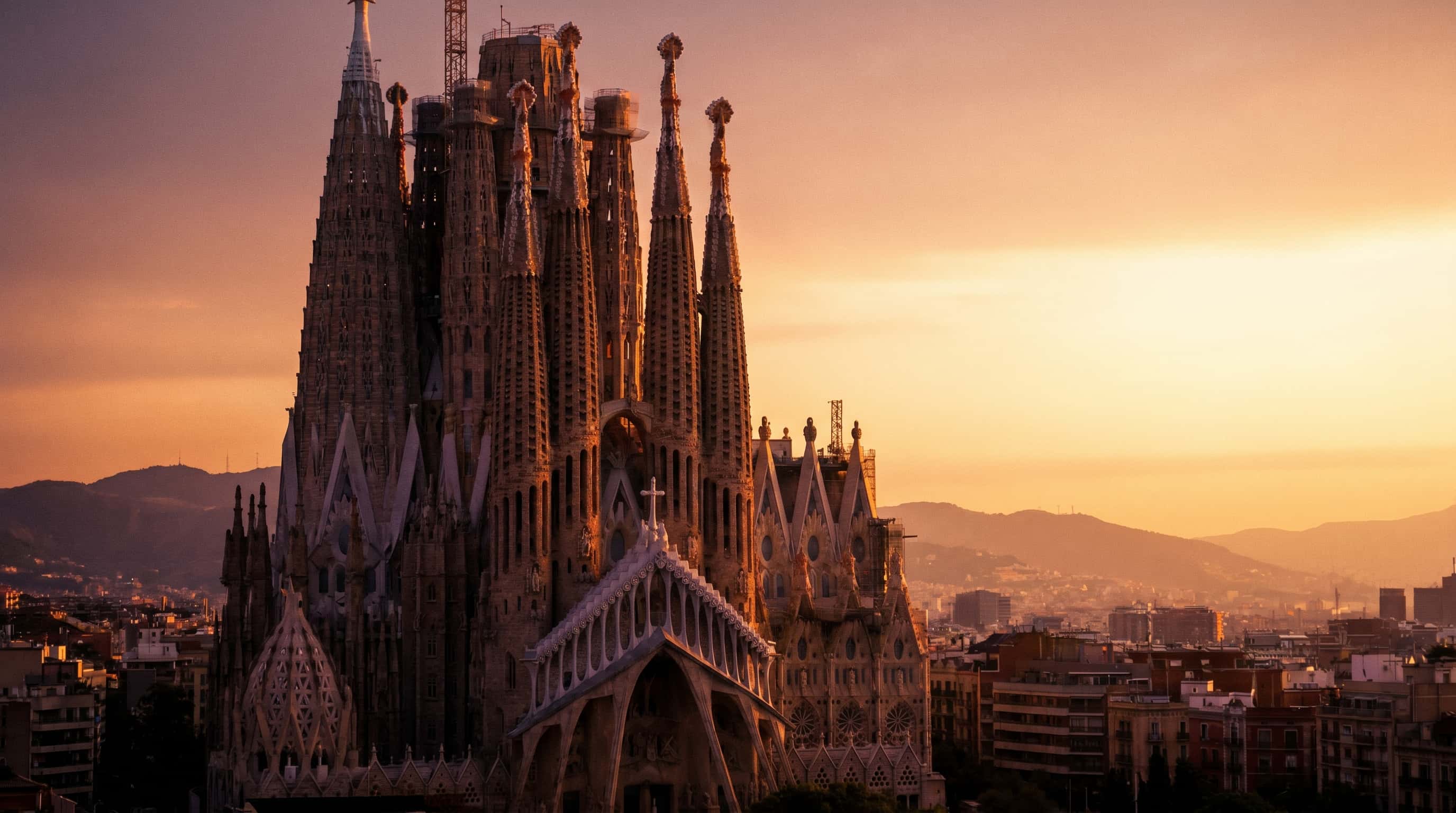
Spain's peak tourist month is August — driven not by ideal conditions but by the European summer holiday calendar that empties offices from Berlin to Brussels for four straight weeks. The signature insight most first-time visitors miss: September temperatures across most of Spain average 25-28°C — barely 2-3°C cooler than August's brutal 30-35°C in Madrid and Barcelona — while hotel prices drop 25-35% and the famous sites operate at a fraction of August's density. The Sagrada Família, the Alhambra, the Prado — all measurably less crowded. The weather barely changes. The experience changes dramatically.
How we evaluated
This verdict draws on three categories of public data. Turespaña, the Spanish Tourism Institute, publishes monthly inbound visitor counts that consistently identify August as Spain's highest-traffic month and show a sharp drop-off entering September. Google Flights historical pricing for US-to-Barcelona (BCN) and US-to-Madrid (MAD) routes provides month-over-month fare data across multiple years. Recurring Spain timing discussions on r/solotravel and r/travel surface September as the dominant community recommendation for experience-to-crowd ratio. No claim of personal travel is made anywhere in this article.
The verdict
September is the single best month to visit Spain for first-time visitors, city-and-beach itineraries, and anyone who wants the iconic sites — Sagrada Família, Alhambra, Prado, Park Güell — without August's wall-to-wall European holiday traffic. Turespaña data consistently shows August as the country's peak and September dropping materially in visitor density, while hotel pricing softens 25-35% and flight fares from US gateways follow. The Worth-It Score is 8.5.
The evidence
Turespaña data shows the August-to-September drop is real
Spain's official tourism statistics from Turespaña consistently rank August as the highest-volume month for international arrivals, with the Mediterranean coast, Barcelona, and Madrid absorbing the heaviest concentration. The September decline is not gradual — it is a step-change driven by the end of European school holidays and the return of French, German, Dutch, and UK workers to their offices. The practical effect is direct: shorter timed-entry queues at the Sagrada Família, more available reservations at the Alhambra Nasrid Palaces, walkable La Rambla in Barcelona, and Madrid neighborhoods like Malasaña and La Latina that feel lived-in rather than crowd-managed. Same sites, same architecture, same tapas culture — at meaningfully lower density.
Pricing data shows 25-35% hotel drops and softening flights
Historical pricing data for major US-to-Spain routes shows September fares running materially below August across multiple years on Google Flights. The hotel pricing differential is sharper. Mid-range Barcelona and Madrid hotels that run €250-350 per night in August routinely drop to €170-230 in September (based on Q1 2026 booking data). Boutique properties in Seville and Granada — already in their slower season after the summer heat peak — show similar percentage moves. For a typical 10-day Spain itinerary covering Barcelona, Madrid, and Andalusia, the September-versus-August total trip cost difference regularly exceeds $800-1,000 per person before factoring in restaurant and activity pricing, which also softens.
The crowd difference at major sites is measurable
The Alhambra in Granada operates on a strict timed-entry system with a daily visitor cap, and August Nasrid Palace tickets routinely sell out weeks in advance, forcing travelers into less-desirable time slots or third-party tour bundling. September restores meaningful same-week availability. The Sagrada Família's published queue times — even with advance tickets — run noticeably longer in August than in September, and the church's interior is one of the most crowd-sensitive religious sites in Europe. The Prado in Madrid, the Royal Palace, Park Güell — every major timed-entry attraction follows the same pattern. Community consensus on r/solotravel and r/travel repeatedly surfaces this as the single most actionable timing insight for first-time Spain visitors.
Regional variation: Andalusia in September is where the gap is largest
Andalusia — Seville, Córdoba, Granada — is the region where the August-to-September shift is most dramatic, because August in Andalusia is genuinely uncomfortable. Seville regularly hits 38-42°C (100-108°F) in August, and even the locals leave. September brings highs back into the 30-33°C range — still warm, but workable for cathedral visits, Alcázar tours, and walking the old quarters. The northern coast — San Sebastián, Bilbao, the Basque Country — is a different calculation. Late August hosts San Sebastián's Semana Grande festival, which is genuinely worth targeting if Basque culture is the trip's centerpiece. But for the iconic Spain itinerary — Barcelona, Madrid, Andalusia — September is the clear answer.
What the community consistently recommends
Recurring "when to visit Spain" threads on r/solotravel and r/travel surface September with near-uniform frequency. The pattern in the responses is consistent: travelers who went in August describe Barcelona as overwhelming and Andalusia as physically punishing; travelers who went in September describe nearly identical weather, half the crowds, and visibly lower bills. The same threads occasionally flag October as a strong alternative — particularly for travelers who specifically want the lowest pricing — with the caveat that beach time on the Mediterranean coast becomes marginal by mid-October.
Who it's best for
For: First-time Spain visitors
The headline itinerary — Barcelona, Madrid, Seville, Granada — is best experienced in September. Every major site is fully open, weather is comfortable, and the August crush is replaced by a measurably calmer pace. For a trip people will remember as their introduction to Spain, September delivers the postcard experience without the queue management.
For: City and beach combiners
September keeps the Mediterranean swimmable along the Costa Brava, Costa del Sol, and Balearics — sea temperatures still run 22-24°C — while the city experience improves dramatically. It is the only month that delivers full beach viability and meaningfully better city conditions simultaneously.
For: Travelers escaping peak-summer pricing
Hotel pricing drops 25-35% versus August and continues to soften through October. For value-conscious travelers who refuse to compromise on weather, September is the most defensible spot on the calendar — peak conditions, post-peak pricing.
What it doesn't beat
September is not the universal best answer. It does not beat August for peak beach-party culture on Ibiza and Mallorca, where the headline club calendar runs at full intensity from late June through August and effectively ends by the middle of September. It does not beat August for the San Sebastián Semana Grande festival, which is a specific reason some travelers target the Basque coast in mid-August. And it does not beat December for the Christmas market atmosphere in Barcelona, where the Fira de Santa Llúcia and the late-fall Catalan dining culture create a genuinely different experience from the summer template. September wins the broad case — but those three specific objectives belong to other months.
Verdict
The Verdict
September Travel Window for Spain
Best For
First-time Spain visitors wanting iconic sites, beach, and food without peak-August pricing and crowds
Beats
August on hotel pricing, crowd density at major sites, and overall pace
Doesn't Beat
August for beach-party culture on Ibiza and Mallorca; December for Christmas market atmosphere in Barcelona
Based on 3 data sources · Last verified May 14, 2026
Sources
- Turespaña (Spanish Tourism Institute) monthly visitor statistics (expert-analysis) — official Spanish government inbound visitor counts identifying August as peak and September's measurable drop-off
- Google Flights historical pricing for US-to-Spain routes (pricing-data) — month-over-month fare data for US-to-Barcelona and US-to-Madrid showing the August-to-September pricing shift
- r/solotravel and r/travel Spain timing consensus (community-consensus) — recurring Spain timing discussions where September emerges as the dominant recommendation for experience-to-crowd ratio