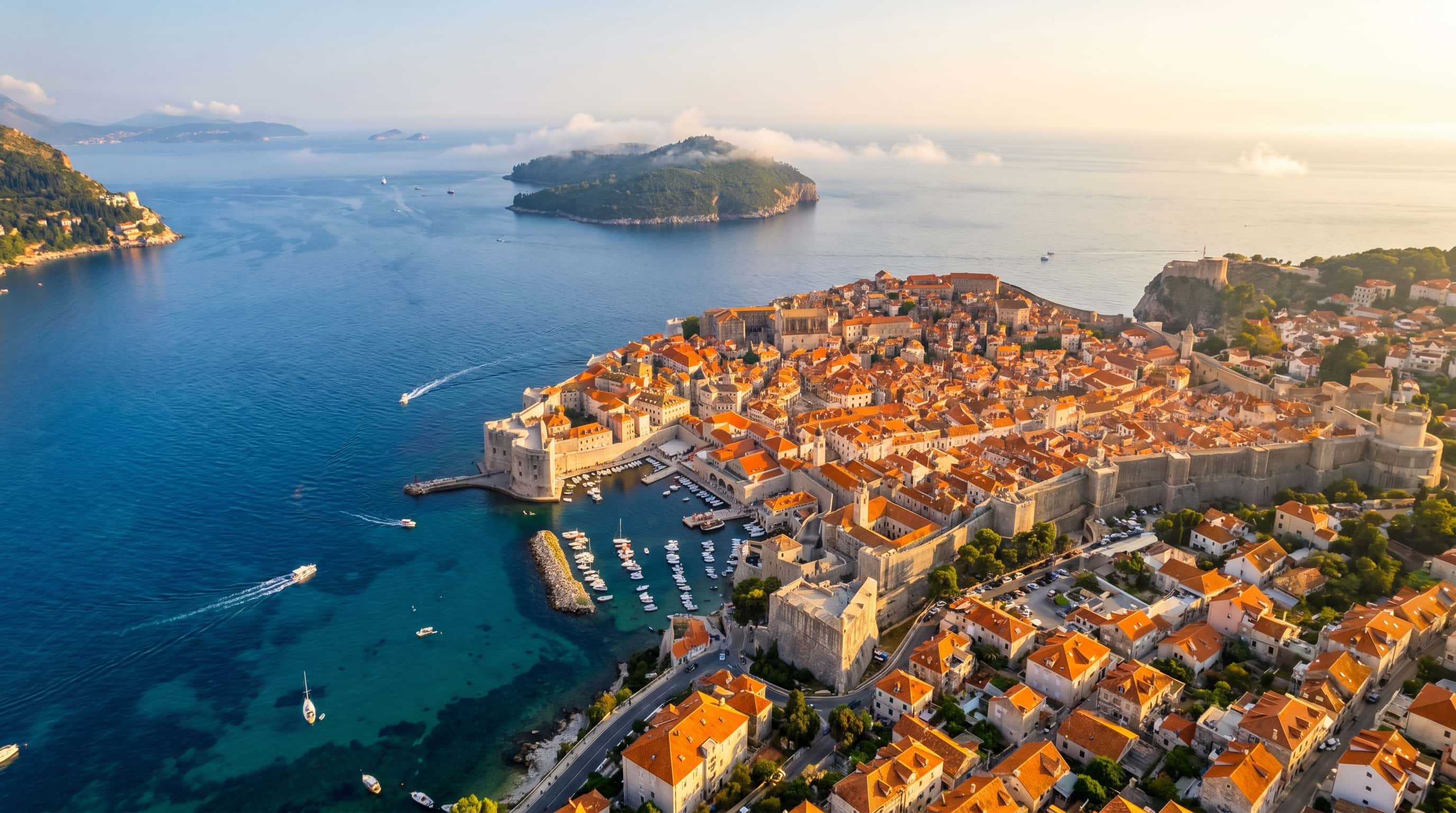
The Adriatic Sea reaches 22°C (72°F) — the threshold most swimmers consider comfortable — by late May. The EU school holiday surge does not peak until July, with the heaviest crowd loads concentrated in the first three weeks of August. Between those two dates sits a narrow 3-week window where Croatia's famous beaches and islands are accessible, swimmable, and dramatically cheaper than peak season. Dubrovnik's Stradun — the single marble street that becomes shoulder-to-shoulder in July — is walkable again. Hvar's old town runs at a pace, not a crush. Accommodation pricing across the Dalmatian coast sits 40-50% below August levels. The window is real, it is narrow, and most first-time Croatia visitors miss it.
How we evaluated
This verdict draws on three categories of public data. The Croatian National Tourist Board (CNTB) publishes monthly inbound visitor statistics by region that document Croatia's extreme July-August peak and the sharp pre-peak drop-off through late May and June. Historical accommodation pricing from Booking.com and Jadrolinija ferry pricing across the major Adriatic routes provide a multi-year comparison between the late-May window and the July-August peak. Recurring r/croatia travel community discussions consistently surface late May to mid-June as the optimal value window for Dubrovnik, Split, and the major islands. No claim of personal travel is made anywhere in this article.
The verdict
Late May to mid-June is the single best window to visit Croatia for travelers focused on the Adriatic coast, the islands, and the country's famous walled old towns. CNTB data shows July and August as one of Europe's most extreme seasonal tourism concentrations — and the late-May-through-mid-June window operates at a fraction of that density while delivering swimmable water, full operating restaurants and ferries, and accommodation pricing 40-50% below peak. The Worth-It Score is 8.5.
The evidence
CNTB data shows Croatia's peak is one of Europe's most extreme
The Croatian National Tourist Board's monthly visitor statistics consistently rank Croatia among the most seasonally concentrated tourism destinations in Europe. July and August absorb a disproportionate share of the country's annual visitor volume, with Dubrovnik, Split, and the Hvar-Brač-Korčula triangle showing the sharpest peaks. The country's tourism economy is structurally built around this two-month window, which means the off-peak drop is correspondingly steep. Late May and June operate at a fraction of August's density — not as quiet as the deep shoulder months of April or October, but materially below the saturation point that defines peak.
The Adriatic water temperature is the unlock
The variable that determines whether Croatia's beach economy is actually viable in a given week is sea temperature. Adriatic water temperature data — published in marine and meteorological summaries across the Croatian coast — consistently shows the Adriatic crossing 22°C (72°F) by the second half of May along the Dalmatian coast, and reaching 23-24°C by mid-June. That is the temperature most swimmers describe as comfortable for sustained water time, and it is the threshold below which beach vacations stop being beach vacations. The narrow point: the water becomes swimmable before the crowds arrive, and the gap between those two dates is the window worth targeting.
Pricing comparison: 40-50% lower accommodation, off-peak ferries
Historical Booking.com pricing for the Dalmatian coast shows mid-range hotels in Dubrovnik, Split, and Hvar running 40-50% below their July-August peaks in late May and early June (based on Q1 2026 booking data). Boutique properties and apartment rentals follow the same percentage move, and many properties offer additional early-season promotions before the calendar shifts. Jadrolinija ferry pricing — the backbone of Croatian island travel — runs at off-peak rates during this window, with shorter sold-out cycles and meaningfully easier same-week bookings. A typical 10-day Croatia coast-and-islands itinerary in the late-May window can run $700-1,000 less per person than the identical itinerary in August.
Dubrovnik specifically — the Game of Thrones crowd dynamic
Dubrovnik is the most crowd-sensitive single destination in Croatia, and its July-August dynamics reflect a combination of three forces: general Mediterranean peak season, Game of Thrones tourism that has persisted long past the show's run, and cruise ship docking schedules that can deposit 5,000+ daily visitors into a walled old town of roughly 1,500 residents. The Stradun — the single marble street running through the old town — becomes a shoulder-to-shoulder bottleneck in peak season, particularly between roughly 10 a.m. and 4 p.m. when multiple cruise ships are docked simultaneously. The late-May window restores the walking pace that the old town is actually designed for. Community consensus on r/croatia consistently flags this as the single largest experience differential between peak and pre-peak Croatia.
Island accessibility — the ferry schedule caveat
The late-May window carries one structural caveat: some Jadrolinija and Krilo ferry routes run reduced schedules before the first or second week of June. Major routes — Split to Hvar, Split to Brač, Split to Korčula — operate on full schedules through May, and Dubrovnik-area ferries to Lokrum and the Elaphiti Islands run normally. But smaller secondary connections, particularly the catamaran routes serving lower-volume islands and some inter-island hops, may not reach full summer frequency until mid-June. Island-hopping itineraries built around the major hubs are unaffected; itineraries that depend on stitching together multiple secondary routes should target the second half of the window rather than the first.
Who it's best for
For: Adriatic beach and island travelers
The water is swimmable, the major ferry routes are running, and the islands are operating without the August crush. For travelers whose trip is centered on Dalmatian coast beaches and island-hopping Hvar, Brač, and Korčula, the late-May-to-mid-June window delivers full beach viability with a fraction of the peak-season density.
For: Budget-conscious Mediterranean visitors
Accommodation pricing 40-50% below August, off-peak ferry rates, and broadly available restaurant reservations make this window the strongest price-to-experience ratio Croatia offers. For travelers comparing Croatia against more expensive Mediterranean alternatives like the French Riviera or the Amalfi Coast, this is when the value gap is widest.
For: Travelers who prioritize walkable old towns
Dubrovnik's Stradun, Split's Diocletian's Palace, and Hvar's old town are all walkable at a real pace in late May and June. The crowd density is meaningfully different from July-August, particularly during cruise ship hours. For travelers whose itinerary is anchored on walking the old towns rather than party islands, this window is the clear answer.
What it doesn't beat
The late-May window is not the universal best answer. It does not beat July and August for the peak Hvar nightlife scene, when the headline beach clubs and the Carpe Diem Beach Club operate at full intensity and the social calendar produces the experience some travelers specifically want. It does not beat peak summer for the warmest water — the Adriatic continues warming through August, and travelers whose primary goal is the warmest possible swimming will get a measurably better water experience in late July through early September. And the ferry schedule caveat is real: some smaller routes run reduced frequency before mid-June, which can complicate island-hopping itineraries built on secondary connections. The window is excellent — but it is not the answer for every Croatia trip.
Verdict
The Verdict
Late May to Mid-June Window for Croatia
Best For
Adriatic travelers who want swimmable water, walkable old towns, and 40-50% lower accommodation pricing
Beats
July-August on crowd density, pricing, and the ability to experience Dubrovnik's old town at a walking pace
Doesn't Beat
July-August for Hvar nightlife and peak island party atmosphere; some ferry routes run reduced schedules before June
Based on 3 data sources · Last verified May 14, 2026
Sources
- Croatian National Tourist Board (CNTB) monthly visitor statistics (expert-analysis) — official monthly inbound data showing July-August as Croatia's extreme peak and the late-May to June drop-off in crowd density
- Booking.com and Jadrolinija ferry pricing data for Adriatic routes (pricing-data) — historical accommodation and ferry pricing comparison between late May and July-August peak periods
- r/croatia travel community timing discussions (community-consensus) — recurring community consensus identifying late May to mid-June as the optimal value window for Dubrovnik, Split, and the islands